
Research Funding · Data Analysis
EU Horizon Europe Research Funding: Data, Trends, and Networks
An analysis of the global distribution of funds, institutional collaboration, and research topics across the 2021–2027 funding period.
Research funding in Europe is currently more in the spotlight than ever before. With the Horizon Europe programme, the European Union is investing billions of euros in innovation, sustainability, healthcare, and technology. As the 2021–2027 funding period nears its end, it is time to analyse the global distribution of funds, cooperation among institutes, and research topics to support well-informed decisions for both scientists and the EU Commission as they plan for the next funding period.
The analysis of the Horizon Europe datasets provided valuable insights. The datasets contain information on countries, institutes, their funded projects, and maximum awarded amounts. The core findings, enhanced with interactive visualisations and rankings, are summarised below.
Which Countries Participate in Horizon Europe Funded Projects?
Very few countries worldwide have no involvement in European Horizon-funded projects. Russia is one of them. All other countries are colour-coded in the interactive map below. The colour scale is based on the sum of funded projects per country, normalised by the number of funded institutes per country.
Project involvement per institute by country. Zoom and drag to explore. Colour intensity reflects the ratio of funded projects to funded institutes.
The highest project involvement per institute is found in European countries such as Greece and Denmark. There are, however, visible differences in project involvement between Eastern and Western Europe. Horizon Europe funded projects also include significant participation from countries across North America, Australia, and Africa, highlighting the programme’s global reach and international collaboration.
Which Research Institutions Are Most Frequently Involved?
The bar chart below shows the absolute number of project participations per institution. Each bar is colour-coded by country.
Top institutions by number of Horizon Europe project participations. Colour represents the institution’s country.
Funding is concentrated among a few major players that hold leading positions across Europe. The French National Centre for Scientific Research (CNRS) leads by a wide margin, followed by the Spanish National Research Council (CSIC) and Germany’s Fraunhofer Society in second and third place. Notably, Denmark, a comparatively small country, ranks highly with three institutes among the top 20.
What Are the Funded Research Projects About?
To answer this question, keywords submitted with the proposals were assessed. The word cloud below shows the top 100 keywords, with the size of each word corresponding to its frequency of occurrence.
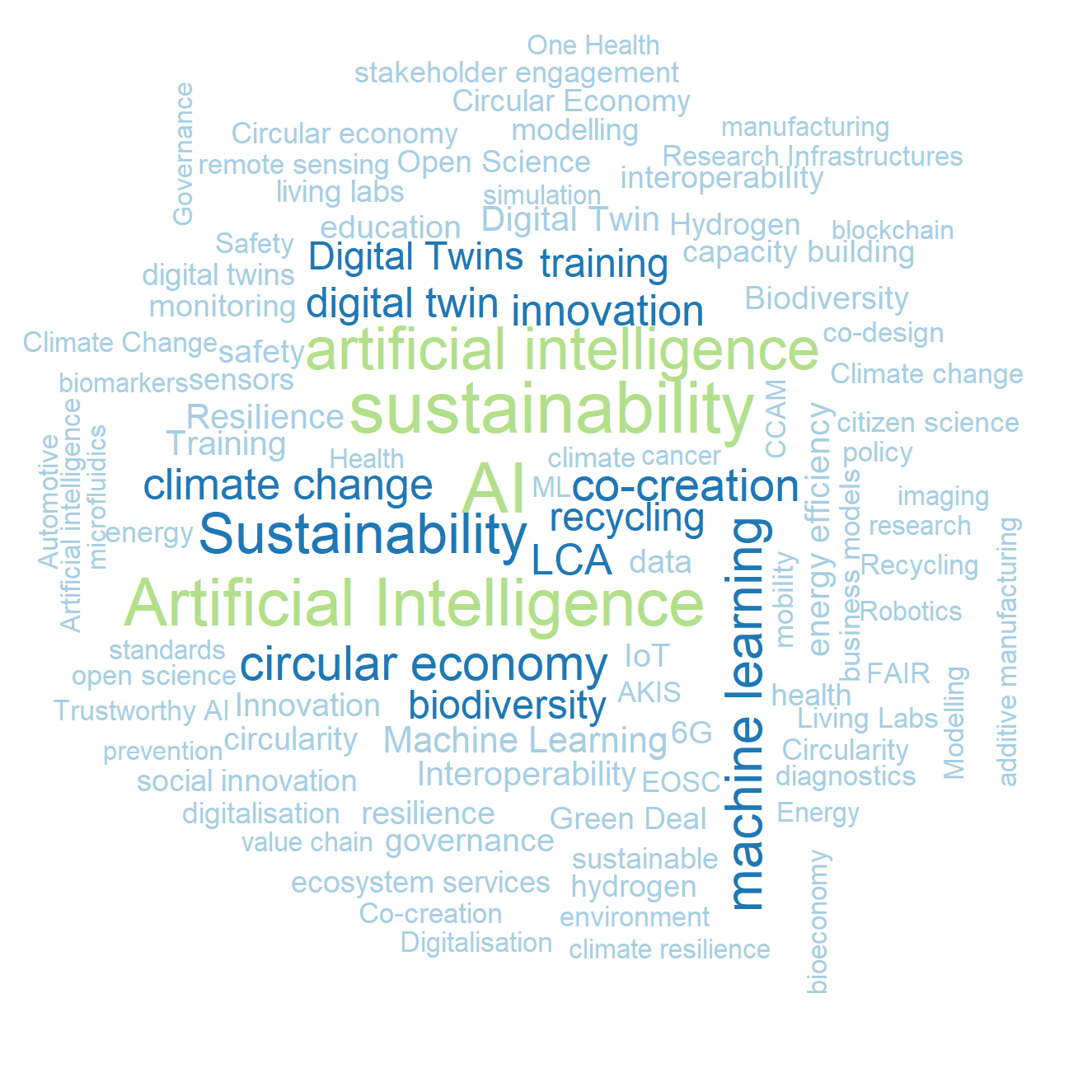
AI research projects are heavily funded, reflecting the considerable attention this topic received during the most recent proposal evaluations. It is encouraging that sustainability and circular economy also rank highly. However, it is surprising to find so few keywords related to life sciences.
Which Institutions Receive the Highest Funding?
The colour coding in the chart below reflects the countries of the institutes.
Top institutions by total awarded Horizon Europe funding (in euros). Colour represents the institution’s country.
The CNRS leads by a wide margin, securing approximately €2.55 billion in total funding. The major Spanish and Italian research institutions occupy the next top ranks.
The Catholic University of Leuven (KU Leuven) stands out as a top recipient of EU research funding, reflecting its exceptional ability to secure substantial grants under Horizon Europe. With more than €170 million awarded across 284 projects, as reported by the university in 2023, KU Leuven owes its success to a well-developed institutional support system, including dedicated grant writing assistance and strong policies fostering innovation. Closely following is the Technical University of Denmark (DTU), which similarly benefits from robust participation in Horizon Europe and other collaborative research initiatives. Both institutions demonstrate how strategic support structures and focused research expertise translate into competitive funding success.
From Germany, the Fraunhofer Society and the Max Planck Society also rank high, reflecting their prominent role in European research. Following these are smaller universities such as Aarhus (Denmark), Ghent (Belgium), and Lund (Sweden), which are notable for their strong research output relative to their size.
Which Countries Receive the Highest Funding?
Total Horizon Europe funding allocation by country.
A review of the funding allocation by country clearly indicates that Western European nations, specifically Spain, France, Italy, and Germany, receive the highest levels of financial support. This is largely attributable to the high concentration of research institutes in these countries. Spain, for example, receives up to €50 billion over the entire funding period.
Collaboration Networks
Collaboration is a key driver of research across Europe and the world, and it ensures that funding is allocated effectively. To better understand the research landscape within Horizon Europe-funded projects, a network-based approach was used to highlight crucial partnerships and identify the most collaborative institutions.
The first network below includes the top 50 institutions that appear most frequently in the dataset. These institutions participate across many projects, indicating broad activity in the research ecosystem.
Network of the 50 most frequently participating institutions. Node size reflects project count; edges represent shared project collaborations.
To take a deeper look at the strongest cooperative relationships, the second network was filtered according to the most frequent collaborating institution pairs.
Network of the strongest institutional collaboration links. Edge thickness indicates the number of shared projects between two institutions.
Although many French institutions are centrally located within the network, the networks themselves are highly unclustered. This suggests that European research collaborations extend well beyond the borders of any single country. The leading institutions in France, Spain, Italy, and Germany play a crucial role in maintaining a robust framework for collaborations across Europe. These organisations serve as hubs, enabling and supporting other institutions within the European research ecosystem. Their central position helps ensure strong connectivity and sustained cooperation among diverse partners across the continent.
Conclusion
The analysis makes it clear that Horizon Europe is more than a funding programme; it is a catalyst for networking and interdisciplinary collaboration that extends globally. While large institutes and Western European countries hold a dominant position, specific partnerships are fostering the emergence of new research hotspots.
As the new funding period approaches, the European Commission faces the task of evaluating project topics, while researchers must strategically reconsider their collaborative partnerships.
Personal Note
Between 2025 and 2027, key orientations of Horizon Europe projects have shifted towards three priorities: green transition, digital transition, and building a resilient, competitive Europe. While this explains why the word cloud contains only limited keywords related to life sciences, from a cancer researcher’s perspective, I would have hoped to see more than just “health” in very small letters.
In my assessment, funding priorities will shift to more significantly incorporate the defence sector, while support for sustainability-focused initiatives may decline. Additionally, to foster cohesion and economic resilience, the European Union will likely increase funding directed toward Eastern European countries. It may be an advantage for future funding rounds to seek collaboration partners in Eastern Europe.